Showing posts with label CPlan. Show all posts

Sunday, March 30, 2025

Term1 Plan for CAA(US32406)

 Unpacked Numeracy Framework: I have been collaborating with other schools and engaging in professional and development opportunities. I participated in external PLD, including Ministry of Education workshops, Calculus PLD, and Auckland Central Cluster PLD with Julia Crawford from Cognition Education. To support consistency and accessibility, a commonly shared folder was shared with teachers.

Resources and support: I have been supporting all teachers(cross-curricular support) by providing weekly numeracy starters( Do nows) activities along with ViTal sheet( tracking sheet) to track progress. These allow teachers to begin lessons with an engaging numeracy problem. 

Here are the resources made for term 1: LINK


Monday, March 13, 2023

Second topic/ Term1

As91264(2.9) Statistical Inference-Internal 4 credits-

This is our second topic with 4 (internal) credits assignment.


What is Statistical Inference? This is a very English-rich standard and continuation work done in

L1 Multivariate data. Effective work of the PPDAC cycle is essential. A lot of writing is involved.

I am planning to break it into 3 checkpoints in order to make this smooth and manageable for my learners.

Here is the plan:

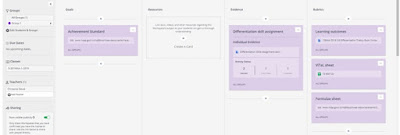
  • Apply SOLO taxonomy- To differentiate between Achievement/Merit/Excellence.

  • Comprehension -Vocab introduced(My definition strategy), underlining the keywords, Acronyms, think loud strategy.

  • Think loud strategy: Recently attended the toolkit workshop by Dr. Naomi Rosedale ( Manaiakalani literacy facilitator) and I found it useful to read and solve problems.

  • PPDAC cycle.

  • ViTaL sheet.

  • Peer teaching- Made them into groups and worked on the whiteboard to build confidence.

  • Workspace and Google Calendar.

  • Video Lessons- Short videos.

  • Google Quizlet flashcards to familiarize yourself with keywords.

  • PEEL Structure to write the analysis.

  • CODAC to create a box and whisker graph-Introduced on calculus day in 2021.

  • Afternoon class for those missed lessons due to other commitments.

  • Checklist to meet all the requirements.


Checkpoint: There are 3 checkpoints.


Checklist:


Think loud strategy:

Think loud PLD 


Think Loud example


Sunday, November 10, 2019

Term4 / Week 2 & 3 monitoring

Raise Māori student achievement through the development of cultural visibility and responsive practices across the pathway as measured against National Standards and agreed targets for reading Years 1-10 and NCEA years 11-13. As a CoL leader within the school. I  am more interested in inquiring about student learning and my own practice.

Monitoring CTD Term4/Week2 and 3


During week 2/3, two students were working hard towards scholarship and eight students were focusing on Complex Numbers and Integration. The idea was that complex numbers/Integration would accelerate mathematical gaps in Algebra and literacy comprehension that would be important in the exams. I encouraged students to learn key points and do a practice test which gave them a grade of Achieved/Merit/Excellence. We took a short, sharp focus; using exemplars to revise and consolidate learning.

Furthermore, three students worked towards an extra internal as two students are not sitting external exams and another one is only sitting one. One student has been absent for the whole term and the other learner is working from home.

I kept emphasizing the importance of going back and consolidating algebra knowledge, by looking at the contextual questions. I did a final quick test, to see how the students were going. Learners had their prize giving on Monday last week (4) and have started their study break on Tuesday.

Next step: Learners will be coming to school during the study break to get in touch with topics as the Calculus examination will be on the 26th of November.


working on internals
Weekend study class
After school study class
weekend study class

Wednesday, October 16, 2019

Term 4 week 2/3 Monitoring Differentiation CTD

Raise Māori student achievement through the development of cultural visibility and responsive practices across the pathway as measured against National Standards and agreed targets for reading Years 1-10 and NCEA years 11-13. As a CoL leader within the school. I  am more interested in inquiring about student learning and my own practice.

Monitoring CTD Term4

This is Term4 and my year13s will be having their study break within three weeks’ time.
As we had a tight deadline the learners came in the holidays for two weeks and worked so hard towards NCEA and scholarship exam past papers.
This is the plan for 3weeks also agreed to come in the study break.
NCEA Calculus exam will be on the 8th of November and Scholarship will be on the 26th of November.


My learners will sit for three externals which are Differentiation, Integration and Complex Numbers. They are using NZQA website past papers, Student exemplars, and you tube videos.
Every week towards the exam there will separate topics for revision as indicated in the plan.
And they must finish three papers within three hours, so they are working on time management too.
Next step: I will post the first-week testing results.

Saturday, August 10, 2019

Monitoring - Differentiation

Raise Māori student achievement through the development of cultural visibility and responsive practices across the pathway as measured against National Standards and agreed targets for reading Years 1-10 and NCEA years 11-13. As a CoL leader within the school. I  am more interested in inquiring about student learning and my own practice.
    
Monitoring
I am working three important hypotheses to monitor my learners’ progress as we are getting closer to the External examinations. In this blog, I am looking at two.
I have been giving them “Do now” s every lesson to figure out the classical mistakes in Algebra as well as rewind their learning to recall what they have learned so far and to dig deeper to find their weaknesses and strengths. Also, most of the time whiteboards have been used by learners as they enjoy working in small groups on a whiteboard. I strongly believe that learners can learn from their mistakes.


   “Do now”
Classical mistakes/Rewinding


They forgot to square the 4.


They struggled with the second question.


Where is sec in the calculator Miss?
They struggled to put that in the calculator.


Few of them struggle to get the correct answer.
 

This was the last lesson  last week,
every single learner got it correct!!


I used whiteboards to address the above hypotheses.

Impact on students:
The students really enjoy having the opportunity to spend part of a lesson out of their seats
The students like having the opportunity to work in small groups with different people each time.
The boards allow the students a public opportunity for solving problems – so students can be affirmed for their expertise and also have the chance to learn from each other.
There is an increased opportunity for conversations around mathematical thinking both with each other and also with me.
Students can take photos of the best practice once they are up on the whiteboards.
Students can present their ideas to each other and to the class while developing their ability to effectively express their mathematical ideas.

Impact on me: 
I have instant feedback as to which students need further support to be able to get started on the current work.
“Do Now” strategy identify easily who understood the work of the previous lesson.
I obtained feedback as soon as a new concept has been introduced.

Next: I will be working on the third hypothesis.

Thursday, August 1, 2019

Intervention design -Integration

Raise Māori student achievement through the development of cultural visibility and responsive practices across the pathway as measured against National Standards and agreed targets for reading Years 1-10 and NCEA years 11-13. As a CoL leader within the school. I  am more interested in inquiring about student learning and my own practice.
    

AS91579 (3.7) Apply Integration methods in solving problems


Achievement
Achievement with Merit
Achievement with Excellence
·      Apply integration methods in solving problems.
·      Apply integration methods using relational thinking, in solving problems.
·      Apply integration methods, using extended abstract thinking, in solving problems.

Plan:

This is the last topic for the year and it is an external topic and I have just started working through integration (3.7, External) with my 13MAA.
I got student input on how to teach this topic and after discussion with my learners, I have developed some teaching strategies.

My practice:
SOLO taxonomy, CHECK CHUNK and CHEW techniques and differentiated teaching in pedagogy will be used.
I will also continue with study classes on Wednesday, Thursday and Friday.
Learners will be sitting a halfway test, end of the topic test and mock examinations which will give them a derived grade.

Intervention: 
The changes I made for my teaching practice, I will apply to this topic for the next 6 weeks.
Link is here.
Hypothesis - Students are unsure how to interpret contextual exam questions, especially at the Merit and Excellence level. I  believe, Practice by using past examinations will help them.
Hypothesis- Students make careless mistakes in Algebra which cost them many marks.I believe cross checking and marking would help them to overcome this.
Hypothesis- rewindable learning-I believe by accessing NZQA wed site will learners to fill the gaps.

Next step:
I will continue in the next blog about monitoring.


Tuesday, July 30, 2019

WFRC #11 &12 : Identify informal & formal ways you are monitoring & Recording

WFRC #11: Identify informal & formal ways you are monitoring
the effects of your changed practices/intervention on learner outcomes.  Explain the reflections and tweaks you are making along the way

WFRC #12: Describe how you will keep a record of each of the above in a manageable way

Over the next six weeks, I am going to start classes with “Do Now” questions which incorporate classic mistakes made by students. This is also to go through rewardable learning techniques and make sure students recall what they have already learned. I will also present exemplars of contextual questions to unpack keywords and skim reading techniques. I will also continue to do practice tests after school for the other two externals as well as scholarship questions.

I am also going to maintain a log to check student progress and keep a record of this on an excel spreadsheet. Testing of progress will be conducted at regular intervals so that if changes to teaching techniques need to be implemented they can be. 

Change  of plan:


Daily planner for the current topic with a timeline for testing/" Do Nows "


WFRC #9 & 10 : Monitoring

WFRC #9: Restate your inquiry question and your theory of action/chain of events (so you keep your eyes on the prize)
WFRC #10: Describe how you will collect information about the implementation of your changed practices/intervention (so it is clear what you do differently)

Monitoring
Throughout the holiday program as I was teaching, listening and marking practice tests I identified three priority learning areas for students.  As this is the last term of teaching and mock exams are in week 9 it is paramount that I am able to implement effective strategies to improve these areas. The three areas are indicated on the flow chart with the respective implementation strategies.

Monitoring


In the next blog post, I will discuss monitoring and keeping records of these strategies

Sunday, May 5, 2019

Yr13 Intervention Linear programming

  • #1.  Raise Māori student achievement through the development of cultural visibility and responsive practices across the pathway as measured against National Standards and agreed targets for reading Years 1-10 and NCEA years 11-13. As a CoL leader within school. I  am more interested in inquiring about student learning and my own practice.
AS91574 (3.2 ) Linear programming( Internal 3 credits)
My learners have finished with their second topic(Differentiation) and will be moving to the third topic tomorrow. This is an online internal test using Demos, I am very excited to get started tomorrow.

I hope this topic will add three more credits towards Achievement or Merit or Excellence as this topic is fun and interactive. My challenge will be in figuring out how to accelerate teaching with in four weeks to gain better grade as this grade contributes towards Merit or Excellence Endorsements.

Achievement
Achievement with Merit
Achievement with Excellence

·       Apply linear programming methods in solving problems.
·       Apply linear programming methods, using relational thinking, in solving problems.
·       Apply linear programming methods, using extended abstract thinking, in solving problems.


I have been working through Linear programming (3.2, Internal) with my 13MAA.
I got student input on how to teach this topic and after discussion with
 my students, I made the following planning decisions:

Intervention Designs:

  •           I am going to apply SOLO taxonomy, Desmos software and differentiated teaching to apply effective,            appropriate pedagogy.
·    I’ve decided to spend more time on forming equations, constraints and optimisation.
·    I have made a site already using Video lessons, Khan academy videos, Online quizzes, Power points and repetitive practice on online  past papers to enhance learning and promote self-directed learning to imitate university life. A ViTal sheet will be used to track their progress.
·    Continuing with study classes on Wednesdays and Fridays after school for greater achievement and teach scholarship too.
  •  At half-way through the topic, I will give them a KWL chart to track progress.
  •  At the end of the topic test, I am going to get feedback from the students to get their strengths and                 weaknesses in order to organize reassessment if needed.
  • Continue to work with Dr Janni van Hees to improve their comprehension skills to form equations, optimization questions.
  •  What is desmos?

Saturday, March 16, 2019

My Inquiry-Plan Year13 (Calculus))


AS91578 (3.6 ) Apply differentiation methods in solving problems


Achievement
Achievement with Merit
Achievement with Excellence

·       Apply differentiation methods in solving problems.
·       Apply differentiation methods using relational thinking, in solving problems.
·       Apply differentiation methods, using extended abstract thinking, in solving problems.


I have been working through Differentiation (3.6, External) with my 13MAA.
I got student input on  how to teach this topic  after discussion with
 my students.
I made the following planning decisions:

I am going to apply SOLO taxonomy, CHECK CHUNK , CHEW technique and
 Differentiated teaching to teach the topic.
I’ve decided to spend more time on contextual word problems, on optimisation, related rate
 of change and properties of graphs (limits, differentiation, concavity and continuity)
 as the students find this most challenging.
I have created workspace using Video lessons, Khan academy videos, Online quizzes,
 Power points, Education perfect and repetitive practice on online  past papers  to 
enhance their learning and promote self-directed learning to imitate university life. 
VTaL sheet will be used to track their progress.
Work space creation    : 


https://workspace.teacherdashboard.com/public/#/w/5c846840ee9aa70973151594
workspace


I have started my Wednesday and Friday study classes to provide extra support
and improve outcomes.
I have divided the topic into two parts- skills and application. Half way through each topic, I will hold a skill test to gauge progress on their skills. At the end of the topic students will
sit a practice test which will imitate the NCEA examination in November.
At the end of the topic test, I am going to get feedback from the students to get their strength

TC Staff mtg PLD