Showing posts with label SReflect. Show all posts

Monday, January 27, 2020

My Inquiry Evaluation including external results

Raise Māori student achievement through the development of cultural visibility and responsive practices across the pathway as measured against National Standards and agreed targets for reading Years 1-10 and NCEA years 11-13. As a CoL leader within the school. I  am more interested in inquiring about student learning and my own practice.
2018


2019


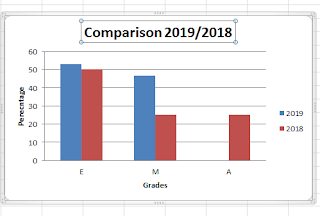
In the externally assessed 91578 Differentiation standard, two students Achieved 20% (2 out of 10) compared to last year’s 43%(6 out of 14.) There were no merits whereas last year there were 7%(1 out of 14). Two students got Excellence 20% (2 out of 10) compared to none last year. Overall 4 learners passed this standard.

The externally assessed 90636 Integration standard went particularly well in 2019. The Achievement rate was 70 % (7 out of 10) compared to last year's rate of 56% (5 out of 9). The Merit rate is 10% ( 1 out of 10) compared to last year's 11% ( 1 out of 9). The Excellence rate was 10% (1 out of 10) compared to none last year. Overall 9 learners passed this standard.

The externally assessed 91577 Complex Numbers standard went well in 2019 too. The Achievement rate was 37.5 % (3 out of 8) compared to last year's rate of 80% (4 out of 5). The Merit rate is 12.5 % (1 out of 8) compared to last year's rate of 20 % (1 out of 5). Excellence was 25% (2 out of 8) compared to none last year. Overall 5 learners passed this standard.

2 students endorsed with Excellence and 1 endorsed with Merit- which is a vast improvement from the 3 merit endorsements last year.

14 (14 out of 15) students gained 14 + credits compare to 9 (9 out of 21) last year. These students are eligible for Engineering, Biomedical, Health science, Law and Architecture. Of these, 3 students are eligible to study engineering at Auckland University as they have passed all three externals.

In 2019, there were 10 students enrolled for externals with 1 student absent due to personal reasons. The highlight is every student has passed at least passed one external which means every single student is eligible for university entrance and 4 students already gained 14+ credits from internals. Thereby having 14 out of 15 students eligible for university entrance is phenomenal. The student left behind stopped coming to school from halfway through term 3. In conjunction with this, a highlight is that there were 3 excellent endorsements and 1 merit endorsement. A student gained Excellence in all three External standards and another gained 2 Excellences which is exceptionally good and a first for Tamaki College.

During the last couple of years as a Calculus teacher, I have been at Tamaki College,  I have seen a positive trend in calculus students passing externals and the majority now gaining university entrance.

Friday, January 24, 2020

Burst and Bubbles

Raise Māori student achievement through the development of cultural visibility and responsive practices across the pathway as measured against National Standards and agreed targets for reading Years 1-10 and NCEA years 11-13. As a CoL leader within the school. I  am more interested in inquiring about student learning and my own practice.

Major Inquiry - How can I accelerate learning in Y13 calculus so that my
Maori students (and other students) can pass exams `by getting at least 14+ credits.
Minor Inquiry- Can I improve the Year 11 numeracy credits by collaborating with one
of my colleagues (one of my hunches!) and also with the technology department.
Personal Goal - As an Assistant HOD is to Increase students’ Mathematics achievement
 in year 12 and Year 13.

As a COL leader within school I am very confident that these three goals would be a
huge contribution towards Achievement challenge 1.

The catalytic aspect of student learning my inquiry focused on this year is
How can I promote self-efficacy, independent learning and imitate university
environments in the classroom at all times.
I identified this as my focus from my past experience students were finding
it difficult to do homework to rewind their learning, how to manage time and
leave everything to the last minute and hard to understand Merit and Excellence
questions.
To build up a rich picture of my learners I used NCEA results from previous
years. Student voice, Pre-test/Post-test/half way test/end of topic test/Mid-year examination
/ Mock examination.
The main patterns of student learning I identified is This is a mixed ability class.
Currently there are 3 students who are working at the expected level, 5-6 students
 who are at an average level and 4 students working below the level. 1 of these
students have never taken calculus before. There are clear gaps here in terms
of mathematics and literacy skills.
My challenge is to accelerate learning to get an entry level for university and teaching
Calculus  scholarship.
My profiling of my own teaching showed that I had strengths in teaching up to scholarship
level and how to meet everyone's needs too.
Two key ideas-
My  students would likely make more progress if I developed in how to use literacy skills
and find extra time to bridge the gap.
Every time I ask my learner to give me feedback to improve my own teaching pedagogy to
move every learner to 14+ credits to get eligible for university entrance.
The changes I made in my teaching were:
Causal Chain-After mid-year exam causal steps are Literacy strategies, student assisted
learning, collaboration with tertiary providers and testing periodically.
Monitoring
As I get closer to externals I did a tweak to my monitoring their progress weekly. By doing
Do now  and weekly tests to improve their accuracy skills.
Literacy strategies played a huge part in calculus I used  KWL chart , chunk check
chew strategy, PEEL structure literacy specialist  and Dr Jannie helped to unpack
M/E Algebraic contextual based questions for them to understand.
The easiest thing is teaching to use online packages-desmos and geogebra to teach
Linear programming (3.2), Systems of equations(3.15) and Trigonometry(3.3).
The hardest thing is to teach 3 externals during class time and how to fit my Calculus
scholarship program. I did lots of after school hours to make this happen. Has been a huge commitment between my students, parents and me
Overall I would rate the changes in student learning as impressive so far as because I offered 5 internal but last year only 3 internals. There are 11 students are willing to sit all 3 of the papers at the end of the year. This is in contrast to only 3 students sitting all 3 last year.
Learners have finished all their internals and are awaiting external results to make a complete evaluation however here is the evaluation for the internals.
Quantitative shift- There is 15 learners in this class. I offered 5 internals according to their strength/carrier pathway- Four learners have gained14+ credits, four students have gained
13+ credits, six students have gained ten credits and one student gained six credits but
last year I offered only three internal and Furthermore, one learner gained six credits which are better with comparing with other subjects.
Qualitative shift- positive attitude, questioning skills, self-efficacy and independent learners
as a result they produced a movie at the film festival. Awaiting for the externals to finalize my evaluation.
The most important learning I made about working on self-efficacy, Independent learning
and questioning skills. According to my understanding it is working. More time needed and pastoral care needed to address these issues
Some learning that would be relevant to other teachers are KWL chart and PEEL
structure and I did PD in my Mathematics department mtg. Collaboration with two of the units (two internal) with my one of my colleagues and one of the internals with two of my colleagues. I strongly believe that collaboration adds motivation and values, when we work together with teachers can identify the common challenges, analyse common data, it can improve our instructional approach.
My Next steps are I am waiting for the external results to finalise 14+ credits and endorsements. Collaboration with other teachers sharing my findings with colleagues/dpt. Feel free to view my blog





Tuesday, November 19, 2019

My Inquiry YR13-Evaluation

Raise Māori student achievement through the development of cultural visibility and responsive practices across the pathway as measured against National Standards and agreed targets for reading Years 1-10 and NCEA years 11-13. As a CoL leader within the school. I  am more interested in inquiring about student learning and my own practice.

Major Inquiry- How can I accelerate learning in Yr13 calculus so that my Maori learners(and the other learners) can pass exams and gain University entrance with getting 14+ credits.
Minor Inquiry- Can I improve the Year 11 numeracy credits by collaborating with one of my colleagues and also technology department.
Personal Goal: The role as  Asst HOD is to increase learners' Mathematical achievement in year 12 and year 13.
As a CoL leader with in school, I am very confident that these three goals would make a huge contribution towards Achievement Challenge 1.

Major inquiry Evaluation

(1) Summarise evidence about key changes in teaching and other factors that influence student           learning: Learners have finished all their internals and are awaiting external results to make a complete evaluation however here is the evaluation for the internals.
The key changes I made over the year
     Catalyst issues- Link
     Causal chain- Link
         Literacy strategies.Link
         NCEA standard breakdowns to understand A/M/E using SOLO taxonomy.Link
         Collaborating with tertiary providers. Link
         Ex-students came to mentor the cultural responsive relational pedagogy.
         Monitoring -Link
         Feedbacks using Google forms, talking, listening and KWL chart.
         Scholarship classes for extension students and extra internal conics taught for them .
         Those who don't sit for external due to their personal reasons, extra internal got taught to gain
          14+ credits. 

    (2)  Summarise evidence about key shifts in the problem of student learning.
          2018 Summary


    2019 Summary


    2019 Summary


    There are 15 learners in this class. Four learners have gained 14+ credits, four students have gained 13+ credits, six students have gained ten credits and one student gained six credits but last year I offered only three internal and Maximum credit gain was only ten credits. So I did differentiated teaching and monitored every learner carefully to reach these outcomes.
    There are 11 students are willing to sit all 3 of the papers at the end of the year. This is in contrast to only 3 students sitting all 3 last year. 
    Furthermore, one learner gained six credits which are better with comparing with other subjects. 


    Internal (1)-Trigonometry


    Trend: This is our first internal. The percentage of students who achieved Merit and Excellence thereby shifted to get higher than achieved.

    internal (2)- Linear programming(3.2)


    Trend: This is ours second internal. The percentage of students of who gained Merit and Excellence has increased, thereby by shifting the achievement level higher than Achieved. Overall,I am happy with these results. Comparing the results with 2018 there has been a 3% increase in learners gaining Excellence and 20% increase in Merit. Consequently, all the learners have gained grade above Achieved.


    Internal (3) -Systems of Equations(3.15)


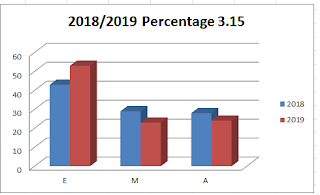
    Trend: This is our third internal. The percentage of students who gained Merit and Excellence has increased. Comparing to results with 2018 there has been a 4% increase in learners gaining Excellence and Merit credits.


    Internal(4)-Conics(3.1) - First time introduced to incorporate with the scholarship the program. The passing rate is 100%.


    Internal(5)- Bi variate data(3.9)- Introduced to make the credits for 14+ as four students will not going to sit for the external exams as they wanted to join the workforce next year. The passing rate is 100%.


     (3) Write an overall evaluation of your intervention in terms of the causal chain you had theorised. i.e.To what extent was the intervention successful in changing factors such as teaching? To what extent were those changes in teaching effectively in changing patterns of student learning?

    Overall comparison with Docile one school and National norm.

    I used causal chain effectively as I mentioned in the previous blogs and I am happy with progress on Quantitative data analysis and qualitative data.

    Quantitative changes; There is a shift in all the internals and the total number of credits compare to 2018.
    Qualitative changes: The learners who were were reluctant to do homework/attending study class decreased. They become independent, engaged effectively with group discussions, improved on questioning skills as a result of they produced a movie at the movie festival.Link

    (4.) Write a reflection on your own professional learning through this inquiry cycle.
    Literacy strategies specially PEEL structure and KWL chart I discussed in the department meeting and my colleagues found it useful too.
    I was able to upgrade my literacy strategies with  Dr. Janni.
    Lena was very helpful with upgrading my blogging skills as this is my first-year CoL leader within the school journey
    The first time, I taught scholarship calculus at Tamaki College it has a huge learning curve and a huge commitment between my two learners and me. my confidence increased and was able to upgrade Level8 Calculus content knowledge.

    TC Staff mtg PLD