Showing posts with label 2021 Inquiry question4. Show all posts

Sunday, May 30, 2021

Inquiry question#4-1,2,3,-Share your finding, how some of the data will be used as baseline data and professional reading.


Inquiry question#4: 
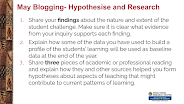
Question4/1: Share your findings on the nature and extent of the student challenge. Make sure it is clear what evidence from your inquiry supports each finding.

I have collected individual students' past year results from kamar. See  blog post is here
The following is the year planner:


Data: My whole class has finished the first internal Number (4credits) last term and here is the blog post of the evaluation.Link

Question4/2:
 Explain how some of the data you have used to build a profile of the students’ learning will be used as baseline data at the end of the year.


The learners have gained 4 credits, the credits they have gained are a huge contribution to my inquiry. 
And I am working on marking and catching on to the second topic (worth 3 credits)  starting the third topic next week. (worth of 4credits).

Question4/3:
 Share three pieces of academic or professional reading and explain how they and other sources helped your form hypotheses about aspects of teaching that might contribute to current patterns of learning.
See blog post is Link.

Next step: Learners just finished their second internal and will be moving towards the third internal next week.

Saturday, May 29, 2021

Professional reading


Reading(1)

 Recently I read a  book about Mathematical Growth Mindsets: Unleashing Students' Potential Through Creative Math, Inspiring Messages and Innovative Teaching by Jo Boaler, and Carol Dweck

The first chapter about The brain and mathematics learning.


The second chapter is about The power of mistakes and struggles-Feel comfortable being wrong,try seemingly wild ideas,  are  open to different experiences, play with ideas without judging them, are willing to go against traditional ideas Keep going through difficulties

The third chapter is about the creativity and the beauty of Mathematics-students learn about brain growth.

The fourth chapter is about how to create mindsets? Knowledge of mathematical patterns has helped people navigate oceans, chart missions to space, develop technology that powers cell phones and social networks, and create new scientific and medical knowledge, yet many school students believe that math is a dead subject, irrelevant to their futures.

The fifth chapter is about rich Mathematics tasks-

The sixth chapter is about Mathematics and the pathway to equity-Offer all students high-level content, 

The seventh chapter is about tracking to a growth mindset. Work to change ideas about who can achieve in mathematics, Encourage students to think deeply about mathematics, teach students to work together, give girls and students of color additional encouragement to learn math and science

The eighth chapter is about assessment for the growing mind-self assessment, peer assessment, reflection time, student write questions and answers.


The ninth chapter is about teaching Mathematics for a growth mindset maths class is all about learning not performing.

The book says everyone can learn Math at the highest level, mistakes are valuable, questions are really important, Math is all about creativity and sense-making, Math is all about connection and communication, value depth over speed and the maths class is all about learning not performing.

Reading (2)Link

Article on Applying the problem-solving approach can have a positive impact on the students of the experimental class. This can be proved from the observation result, the observation result shows the students become better and able to solve in an experimental class. Link

Reading(3)

Robert Kaplinsky's 3Act task-Hot dog problem -Link

Act 1-Provocation- I wonder-----, I notice------, Just brainstorm.

   Act 2-Investigation-tease out some key things.

Act3-generalization.what information they found to find the answer.


Firstly learners watch the video and dividing the lessons into 3Act tasks as seen above. Love the idea and worked in my department last week. Hot dog task is an excellent way to introduce linear patterns. 

This reading provides me with practical strategies and practical activities to grow their mindset and tease out all their ideas before making a generalization. 


TC Staff mtg PLD