Showing posts with label My Inquiry Questions. Show all posts

Tuesday, November 19, 2019

My Inquiry YR13-Evaluation

Raise Māori student achievement through the development of cultural visibility and responsive practices across the pathway as measured against National Standards and agreed targets for reading Years 1-10 and NCEA years 11-13. As a CoL leader within the school. I  am more interested in inquiring about student learning and my own practice.

Major Inquiry- How can I accelerate learning in Yr13 calculus so that my Maori learners(and the other learners) can pass exams and gain University entrance with getting 14+ credits.
Minor Inquiry- Can I improve the Year 11 numeracy credits by collaborating with one of my colleagues and also technology department.
Personal Goal: The role as  Asst HOD is to increase learners' Mathematical achievement in year 12 and year 13.
As a CoL leader with in school, I am very confident that these three goals would make a huge contribution towards Achievement Challenge 1.

Major inquiry Evaluation

(1) Summarise evidence about key changes in teaching and other factors that influence student           learning: Learners have finished all their internals and are awaiting external results to make a complete evaluation however here is the evaluation for the internals.
The key changes I made over the year
     Catalyst issues- Link
     Causal chain- Link
         Literacy strategies.Link
         NCEA standard breakdowns to understand A/M/E using SOLO taxonomy.Link
         Collaborating with tertiary providers. Link
         Ex-students came to mentor the cultural responsive relational pedagogy.
         Monitoring -Link
         Feedbacks using Google forms, talking, listening and KWL chart.
         Scholarship classes for extension students and extra internal conics taught for them .
         Those who don't sit for external due to their personal reasons, extra internal got taught to gain
          14+ credits. 

    (2)  Summarise evidence about key shifts in the problem of student learning.
          2018 Summary


    2019 Summary


    2019 Summary


    There are 15 learners in this class. Four learners have gained 14+ credits, four students have gained 13+ credits, six students have gained ten credits and one student gained six credits but last year I offered only three internal and Maximum credit gain was only ten credits. So I did differentiated teaching and monitored every learner carefully to reach these outcomes.
    There are 11 students are willing to sit all 3 of the papers at the end of the year. This is in contrast to only 3 students sitting all 3 last year. 
    Furthermore, one learner gained six credits which are better with comparing with other subjects. 


    Internal (1)-Trigonometry


    Trend: This is our first internal. The percentage of students who achieved Merit and Excellence thereby shifted to get higher than achieved.

    internal (2)- Linear programming(3.2)
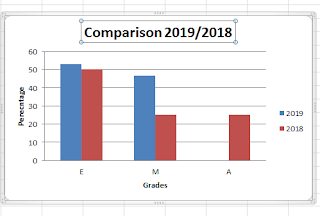
      

    Trend: This is ours second internal. The percentage of students of who gained Merit and Excellence has increased, thereby by shifting the achievement level higher than Achieved. Overall,I am happy with these results. Comparing the results with 2018 there has been a 3% increase in learners gaining Excellence and 20% increase in Merit. Consequently, all the learners have gained grade above Achieved.


    Internal (3) -Systems of Equations(3.15)
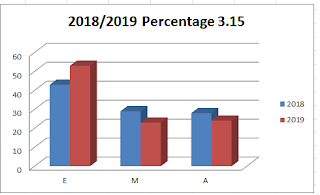


    Trend: This is our third internal. The percentage of students who gained Merit and Excellence has increased. Comparing to results with 2018 there has been a 4% increase in learners gaining Excellence and Merit credits.


    Internal(4)-Conics(3.1) - First time introduced to incorporate with the scholarship the program. The passing rate is 100%.


    Internal(5)- Bi variate data(3.9)- Introduced to make the credits for 14+ as four students will not going to sit for the external exams as they wanted to join the workforce next year. The passing rate is 100%.


     (3) Write an overall evaluation of your intervention in terms of the causal chain you had theorised. i.e.To what extent was the intervention successful in changing factors such as teaching? To what extent were those changes in teaching effectively in changing patterns of student learning?

    Overall comparison with Docile one school and National norm.

    I used causal chain effectively as I mentioned in the previous blogs and I am happy with progress on Quantitative data analysis and qualitative data.

    Quantitative changes; There is a shift in all the internals and the total number of credits compare to 2018.
    Qualitative changes: The learners who were were reluctant to do homework/attending study class decreased. They become independent, engaged effectively with group discussions, improved on questioning skills as a result of they produced a movie at the movie festival.Link

    (4.) Write a reflection on your own professional learning through this inquiry cycle.
    Literacy strategies specially PEEL structure and KWL chart I discussed in the department meeting and my colleagues found it useful too.
    I was able to upgrade my literacy strategies with  Dr. Janni.
    Lena was very helpful with upgrading my blogging skills as this is my first-year CoL leader within the school journey
    The first time, I taught scholarship calculus at Tamaki College it has a huge learning curve and a huge commitment between my two learners and me. my confidence increased and was able to upgrade Level8 Calculus content knowledge.

    Sunday, September 22, 2019

    Term 3(week 8) Derived examination Evaluation

    Raise Māori student achievement through the development of cultural visibility and responsive practices across the pathway as measured against National Standards and agreed targets for reading Years 1-10 and NCEA years 11-13. As a CoL leader within the school. I  am more interested in inquiring about student learning and my own practice.

    Evaluation (week8) with Derived grade examination for Differentiation and Integration

    Week8(the week before last week) the students sat their Derived Grade Examinations. The learners sat 2 of the papers; Differentiation and Integration. They revised well and I am pleased with their performance.
    The whole the class sat for differentiation and got good results; with 2 Excellences, 6 Merits and the rest of achieving the unit.
    10 students sat for integration with results spread over; 2 Excellences, 3 Merits, 3 Achieved and 2 not Achieved.
    From these results, there still needs to be more work done in integration, however this topic was only finished recently so more time is needed for consolidation.
    The students are achieving better after introducing my three hypotheses. More work still needs to be given to Merit and Excellence questions.


    Next step: Currently learners are working on the third external paper (Complex Numbers) and the quick test  and derived examination is in week 10.


    Monday, September 9, 2019

    Term3 Monitoring CTD for Differentiation

    Raise Māori student achievement through the development of cultural visibility and responsive practices across the pathway as measured against National Standards and agreed targets for reading Years 1-10 and NCEA years 11-13. As a CoL leader within the school. I  am more interested in inquiring about student learning and my own practice.

    Monitoring CTD(week7) for Differentiation
    Last week I spend the whole week revising the differentiation topic and gave students a quick test.
    I was working towards my three hypotheses which are Do now’s to fix classic mistakes in Algebra, rewindable learning and Merit/Excellence questions as I did for the Integration topic.

    The learners and I worked towards the prize. We are getting closer to reaching these goals. Unfortunately, a few students were sick last week, so I will have to do some catch-up work with them when they are back.


    Here are results and feedback


    Next step: This week Learners will be sitting there mock examinations (derived grade exam). There are three externals for this course but in week 8(this week) they will only be sitting two papers (Differentiation and Integration). Will be sitting their third paper(Complex Numbers) in week9/10.

    Action plan after the Mock examination: Reteach the topics and continue to work on rewindable learning to use practice exams using the NZQA website.


    Monday, September 2, 2019

    Term3 -Monitoring- Integration

    Raise Māori student achievement through the development of cultural visibility and responsive practices across the pathway as measured against National Standards and agreed targets for reading Years 1-10 and NCEA years 11-13. As a CoL leader within the school. I  am more interested in inquiring about student learning and my own practice.

    Monitoring CTD

    Third Hypothesis: Students are unsure how to interpret contextual exam questions, especially at the Merit and Excellence level.
    Last week I have been working on my third hypotheses with Dr Janni.

    Here is the example (1) 

    Key steps before Answering: 
    Step1: Circle the keywords such as; Diagram, Function F(x), point(k,k), contained and shaded area.
    Step2: Unpack the questions as underlined.
    Step3: Draw all the wanted information in a diagram.
    Step4: Answer the questions

    Here is the example (2)


    Key steps before Answering: 
    Step1: Circle the keywords as rounded; Object’s acceleration, object, velocity, how far.
    Step2: Unpack the questions as underlined.
    Step3: Draw all the wanted information in a diagram.
    Step4: Answer the questions.

    Here is the example (3)


    Key steps before Answering: 
    Step1: Circle the keywords as rounded; .Mass, burning candle, velocity.
    Step2: Unpack the questions as underlined.
    Step3: Draw all the wanted information in the diagram.
    Step4: Answer the questions.

    I gave students a practice test last week, and I was really impressed with how much work ethic had improved. There was a noticeable improvement in algebra with fewer careless mistakes. The rewindable learning technique and Dr Janni’s strategy has really facilitated students in achieving Excellence. Here are the results:  


    Name
     AS91579 Integration practice test
    AS91579 Integration practice test(Mock examination)
    Student A
    WD

    Student B
    ab

    Student C
    WD

    Student D
    M

    Student E
    M

    Student F
    M

    Student G
    M

    Student H
    E

    Student I
    M

    Student J
    M

    Student K
    A

    Student L
    WD

    Student M
    E

    Student N
    WD

    Student O
    M


    There are three external examinations in this course and  all of them will be sitting one external and a few selected students will be sitting all three depending on their career pathway. 
    As you can see four learners did not sit this exam. Two students are working on the Excellence level and most students are aiming for a Merit level. Learners are working hard towards Mock examinations which will be the last practice and is important as it will give them their derived grade.

    Next step: Revising for mock examinations

    Wednesday, August 21, 2019

    Reading in Maths

    Raise Māori student achievement through the development of cultural visibility and responsive practices across the pathway as measured against National Standards and agreed targets for reading Years 1-10 and NCEA years 11-13. As a CoL leader within the school. I  am more interested in inquiring about student learning and my own practice.

    Junior Mathematics and reading

    There are five strands in Mathematics; Number, Algebra, Geometry, Measurement, and Statistics + Probability.
    I strongly believe that if learners’ have a strong understanding in Number this will facilitate the learning in the other topics. This was a lesson in Percentage (number) and I really enjoyed teaching it. I learned about this approach from the numeracy project introduced to the school by facilitators.

    The strategy is to change the English version into mathematical language
    Calculate the answer using the double number line strategy.

     Here is the ppt


    Year11 Mathematics and reading-Number-As91026(4 credits)

    Attached is one of the practice tests I prepared for my learners.

    It’s Your Party!!
    You are planning your 16th birthday party.
    You are inviting 32 friends to attend your party.
    All the invites are sent out and you realise that you have invited boys and girls in the ratio of 3:5.
    Everyone has replied that they are coming to your birthday.
    You find out that ¼ of the guests are vegetarians.
    The caterer you are using tells you, that you as the birthday person you will not have to pay for any food or drink that you eat.
    The price of a vegetarian meal is $11.25.
     The price for a non-vegetarian meal is 11% more than the cost of a vegetarian meal.
    Drinks are going to cost you $2.75 per drink.
    A boy will drink twice as many drinks as a girl.
    Each girl will drink 3 drinks at the party.
    All the prices are GST exclusive (GST is 15%).
    1. Your father has asked you to calculate how much the party is going to cost, including GST.
    2. Your father is aware that there may be a change of government soon and the opposition party have promised to change the rate of GST as soon as they are elected. This change will come into effect before you buy the food and drink for the party. Your father believes the new GST rate could be anything between 10% and 18%. He also expects there to be a different GST rate for food than for drinks. He would like you to inform him what the possible consequences of these changes might be to the cost of the party.

    The strategy is to underline the keywords first.
    Unpack the statements and create a table as shown below.


    Statement(KNOW)

    Working
    Answer(unit)
    Total guests
    32


    Boys (ratio)
    3 out of 8
    3/8 x 32
    12 boys
    Girls (ratio)
    5 out of 8
    5/8 x 32
    20 girls
    Vegetarians (fraction
    of quantity))
    ¼ of the guests
    ¼ x 32
    8 guests
    Price for vegetarian food
    $11.25
    8 x 11.25
    $90
    Price for Non-Veg
    (percentage increase)
    11%  more=111%
    1.11 X 11.25
    =$12.49
    24 x 12.49 = $299.76
    etc


    When the learners started to unpack their ideas into a table, it made it easier for them to understand the different aspects of the questions. It is also a clear format for all the information that they could use throughout their calculations. I did many practice questions using this approach and most students managed to get their 4 credits. 

     Marking schedule

    TC Staff mtg PLD