Showing posts with label 2019ColloborativeInquiry. Show all posts

Tuesday, November 19, 2019

My Inquiry YR13-Evaluation

Raise Māori student achievement through the development of cultural visibility and responsive practices across the pathway as measured against National Standards and agreed targets for reading Years 1-10 and NCEA years 11-13. As a CoL leader within the school. I  am more interested in inquiring about student learning and my own practice.

Major Inquiry- How can I accelerate learning in Yr13 calculus so that my Maori learners(and the other learners) can pass exams and gain University entrance with getting 14+ credits.
Minor Inquiry- Can I improve the Year 11 numeracy credits by collaborating with one of my colleagues and also technology department.
Personal Goal: The role as  Asst HOD is to increase learners' Mathematical achievement in year 12 and year 13.
As a CoL leader with in school, I am very confident that these three goals would make a huge contribution towards Achievement Challenge 1.

Major inquiry Evaluation

(1) Summarise evidence about key changes in teaching and other factors that influence student           learning: Learners have finished all their internals and are awaiting external results to make a complete evaluation however here is the evaluation for the internals.
The key changes I made over the year
     Catalyst issues- Link
     Causal chain- Link
         Literacy strategies.Link
         NCEA standard breakdowns to understand A/M/E using SOLO taxonomy.Link
         Collaborating with tertiary providers. Link
         Ex-students came to mentor the cultural responsive relational pedagogy.
         Monitoring -Link
         Feedbacks using Google forms, talking, listening and KWL chart.
         Scholarship classes for extension students and extra internal conics taught for them .
         Those who don't sit for external due to their personal reasons, extra internal got taught to gain
          14+ credits. 

    (2)  Summarise evidence about key shifts in the problem of student learning.
          2018 Summary


    2019 Summary


    2019 Summary


    There are 15 learners in this class. Four learners have gained 14+ credits, four students have gained 13+ credits, six students have gained ten credits and one student gained six credits but last year I offered only three internal and Maximum credit gain was only ten credits. So I did differentiated teaching and monitored every learner carefully to reach these outcomes.
    There are 11 students are willing to sit all 3 of the papers at the end of the year. This is in contrast to only 3 students sitting all 3 last year. 
    Furthermore, one learner gained six credits which are better with comparing with other subjects. 


    Internal (1)-Trigonometry


    Trend: This is our first internal. The percentage of students who achieved Merit and Excellence thereby shifted to get higher than achieved.

    internal (2)- Linear programming(3.2)
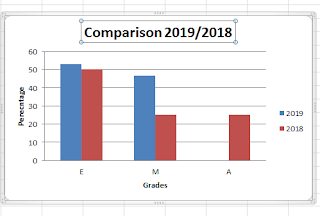
      

    Trend: This is ours second internal. The percentage of students of who gained Merit and Excellence has increased, thereby by shifting the achievement level higher than Achieved. Overall,I am happy with these results. Comparing the results with 2018 there has been a 3% increase in learners gaining Excellence and 20% increase in Merit. Consequently, all the learners have gained grade above Achieved.


    Internal (3) -Systems of Equations(3.15)
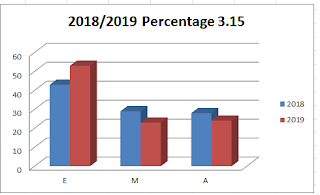


    Trend: This is our third internal. The percentage of students who gained Merit and Excellence has increased. Comparing to results with 2018 there has been a 4% increase in learners gaining Excellence and Merit credits.


    Internal(4)-Conics(3.1) - First time introduced to incorporate with the scholarship the program. The passing rate is 100%.


    Internal(5)- Bi variate data(3.9)- Introduced to make the credits for 14+ as four students will not going to sit for the external exams as they wanted to join the workforce next year. The passing rate is 100%.


     (3) Write an overall evaluation of your intervention in terms of the causal chain you had theorised. i.e.To what extent was the intervention successful in changing factors such as teaching? To what extent were those changes in teaching effectively in changing patterns of student learning?

    Overall comparison with Docile one school and National norm.

    I used causal chain effectively as I mentioned in the previous blogs and I am happy with progress on Quantitative data analysis and qualitative data.

    Quantitative changes; There is a shift in all the internals and the total number of credits compare to 2018.
    Qualitative changes: The learners who were were reluctant to do homework/attending study class decreased. They become independent, engaged effectively with group discussions, improved on questioning skills as a result of they produced a movie at the movie festival.Link

    (4.) Write a reflection on your own professional learning through this inquiry cycle.
    Literacy strategies specially PEEL structure and KWL chart I discussed in the department meeting and my colleagues found it useful too.
    I was able to upgrade my literacy strategies with  Dr. Janni.
    Lena was very helpful with upgrading my blogging skills as this is my first-year CoL leader within the school journey
    The first time, I taught scholarship calculus at Tamaki College it has a huge learning curve and a huge commitment between my two learners and me. my confidence increased and was able to upgrade Level8 Calculus content knowledge.

    Monday, June 3, 2019

    My Colloborative Inquiry Yr11- Evaluation

    WRFC(5) Begin to collect evidence and data and come to the next session ready to share your preliminary findings about the nature and extent of the student challenge i.e. using your baseline student data and evidence

    Transformation Geometry Evaluation:
    I have collected individual students' PAT results from kamar blog post is here.
    Data:


    Trends and students’ voice:
    I have just finished our marking, moderation and making key tags on this internal. 
    Ms Karen Ferguson spent lots of time making key tags which is very time consuming.
    13 students gained Achieved, 9 gained Merits, one was absent and two of them are still working on the task as they are ESOL students. Dr Yanee’s strategies worked too and I am going to continue to work with her to get better grades for the next topics.
    There is a shift in the learners’ achievement. This was a collaborative activity task, cultural based, interactive and fun topic. I am unable to do comparison as we have implemented this task for the first time in recent years. When the results for this standard are compared with the results for the first topic results in term1(same group of learners) there is a increase in the number of Merit achieved.
    Definitely this two credit Achievement Standard is going to contribute towards Numeracy credits.
    My colleagues and I were able to develop professional learning by interacting with each other as well as with the learners.
    According to the student voice they also found the task really interesting.


    Key tags


    Next step: Going to work with Dr Yanee.


    Thursday, April 18, 2019

    My Collaborative Inquiry Year 11

    WFRC#(4) Describe the tools/measures/approaches you plan to use to get a more detailed and accurate profile of students’ learning in relation to that challenge. Justify why you chose these approaches and tools
    Minor Collaborative inquiry - Can I improve the Year 11 numeracy credits by collaborating with one of my colleagues (one of my hunches!) and also the technology department?
    My hunches are- I need to apply literacy strategies  and SOLO taxonomy effectively in order gain Achievement/Merit/Excellence. Hence, how to carryout an effective Collaboration Inquiry?

    The Problem to be solved is:
    First Name
    Ethnicity
    PAT
    Stanine
    2018
    Transformation Geometry
    (AS91034)
    2 Cr
    Student 1
    Maori
    4


    Student 2
    Tongan
    2


    Student 3
    Niuean
    3


    Student 4
    Cook Island Maori
    4


    Student 5
    Cook Island Maori
    3


    Student 6
    Maori
    3


    Student 7
    Tongan
    new


    Student 8
    Tongan
    2


    Student 9
    Samoan
    2


    Student 10
    Tongan
    3


    Student 11
    other
    new


    Student 12
    Maori, Indian
    3


    Student 13
    Cook Island Maori
    3


    Student 14
    Cook Island Maori
    3


    Student 15
    Filipino
    new


    Student 16
    Cook Island Maori
    3


    Student 17
    Tokuluan maori
    new


    Student 18
    Tongan
    3


    Student 19
    Cook Island Maori
    4


    Student 20
    Tongan
    4


    Student 21
    Tongan
    3


    Student 22
    Cook Island Maori
    1


    Student 23
    Tongan
    3


    Student 24
    Tongan
    new


    Student 25
    Maori
    new


    Student 26
    Maori
    ab


     The above data shows that the students range from Stanine 2-4.
    My challenge will be in figuring out  how to accelerate teaching within a short period.
    There are 3 international students struggling with the writing and reading skills

    My Tools/Measures/Approachers are:

    • Knowing the learner-Approach according to ethnicity background and past year PAT results using Kamar, helps to apply differentiated teaching according to their ability.
    • Formative assessments and practice tests in internally assessed topics will help students gain Numeracy credits.
    • Student Voice- Instead of simply making assumptions about how best to support students, I am interested in collecting student voice using; google forms, Blogging and videos.
    • Promote Mathematical literacy/reading in class to understand the Merit/ Excellence questions to gain better grades.
    • Teaching SOLO taxonomy to understand the breakdown of Achievement, Merit and Excellence in NCEA to gain endorsements.
    • Using work space and videos to set effective lessons in revising and reviewing before tests.
    • Using literacy strategies to understand new concepts.
    • Incorporate google drawing into Transformation geometry to increase engagement.
    • Peer teaching- Learners feel more comfortable and open when interacting with their peers.
    • Weekly catch ups with Mr Nilesh Krishna and Ms Karen Ferguson for effective collaboration.
    • Creating key tags using design to make this topic meaningful.

    Saturday, April 13, 2019

    Term1-Year 11- My Collaborative Inquiry Reflection


    #1.  Raise Māori student achievement through the development of cultural visibility and responsive practices across the pathway as measured against National Standards and agreed targets for reading Years 1-10 and NCEA years 11-13. As a CoL leader within school I  am more interested in inquiring about student learning and my own practice.


    My Learners have completed the First stage of the internal on the last day of the school.
    And they will be completing the second stage(Laser cutting)  next term.

    Learners' Blog

    Monday, April 8, 2019

    Meeting with Dr. Janni van Hees

    Meeting with Dr. Janni van Hees

    As part of our Collaboration Inquiry, and I met with Dr. Janni van Hees last week, helped me with few guidelines to describe Transformations hence students are struggling to describe what they have drawn in the practice task.
    And  part of my challenge to use responsive practices as a pathway to achieving students will be reflect on their learning, this will help to understand where they are on the pathway to achievement.

    Practice task: Create a shape using Reflection, Rotation, Translation, Enlargement and Describe.

    Practice test


    •     Learners are to record all the keywords of Transformation Geometry.


    •  Learners are saying it with the (articulate) accurate Mathematical language →Learners are to write it ↔ teacher feedback
    •     Thinking fluency and writing fluency must be accurate.
    •    Write a cultural story and a Mathematical story behind the design.


    TC Staff mtg PLD