
My learners found it useful to follow the SOLO taxonomy to work on Achievement, Merit, and Excellence.

My learners found it useful to follow the SOLO taxonomy to work on Achievement, Merit, and Excellence.
SOLO taxonomy helps learners to identify between Achievement/ Merit/ Excellence.
Here is the breakdown:
 |
I found SOLO taxonomy used to enhance teaching, learning, assessment, and curriculum design.
My learners found this useful to reach their desired grades.

I found the SOLO taxonomy to be extremely useful for differentiated teaching, as well as my own for my own learning.


ACHIEVEMENT
Candidates who were awarded Achievement for this standard demonstrated the required skills and knowledge. They commonly:
• calculated probabilities or percentages using either Normal Distribution Tables or a Graphics calculator
• calculated probabilities using Probability Tree Diagrams
• calculated probabilities or proportions from the information presented in contingency tables.
ACHIEVEMENT WITH MERIT
In addition to the skills and knowledge required for the award of Achievement, candidates who were awarded Achievement with Merit commonly:
• inverse normal distribution problems.
• applied calculated probabilities or proportions to determine the expected value for a situation and gave the answer as a whole number for a discrete situation
• compared features of a sample distribution with a Normal Distribution by partially describing
similarities/differences using correct statistical terms
• calculated probabilities for multiple events using Probability Tree Diagrams
• could set up and solve a linear probability equation.
ACHIEVEMENT WITH EXCELLENCE
In addition to the skills and knowledge required for the award of Achievement with Merit, candidates who were awarded Achievement with Excellence commonly:
• applied their understanding of inverse Normal Probability situations to find an unknown parameter
(e.g. could find a new mean or standard deviation)
• could compare in depth the features of a sample distribution with a Normal Distribution by fully describing similarities/differences using correct statistical terms
• found a conditional probability for an event using either an extended probability tree diagram or conditional probability rule
• determined relative risks and drew a conclusion relating to a claim about the events occurring

The Solo Taxonomy model helps learners to understand and think when analyzing statistical experiments. The framework guides to identify the areas of improvement and moves toward high-level thinking to gain higher-level grades.


My learners found SOLO useful to have a better understanding of the difference
between Achievement/ Merit/ Excellence.


Achievement-2 different techniques from gradient, Length, and distance.
Merit- 2 different descriptions of the shapes.
Merit- Proof of two observations from the findings.

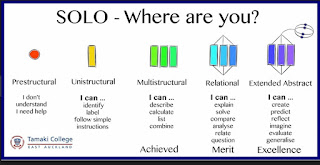
I use SOLO taxonomy to describe the different levels of thinking in the standards.
The stages in the SOLO taxonomy are increasing in quantity and quality of thought.

Achievement
Merit
Excellence
I found the SOLO taxonomy very useful to differentiate between Achievement, Merit, and Excellence.
Here is the breakdown.
|
Achievement |
Merit |
Excellence |
|
Pose a question using 2 qualitative variables and one quantitative variable. |
|
|
|
Create 2 graphs Box and Whisker Dot Plot |
|
|
|
Provide summary statistics |
|
|
|
Analysis State at least 2 features comparing the two variables
|
|
3 different features discussed in context giving reasons and meaning to the comments. Centre Spread Shape of Distribution |
|
Answer the question OR make an informal reference to the population |
Answers the question with evidence to justify. Gives a statement about the medians in making a call or states it is too close to call with evidence.
Refers back to population |
Makes a call citing comparison of medians OR mid 50% Must refer back to Population
No Contradictions
3 comments showing abstract thinking eg Variability Expected results Contextual knowledge Other contributing Factors |
| |
Achievement | Correct measurement and uses at least three different numeric methods in an attempt to solve the problem. Measurement And 1)Find any side of a right-angled triangle using Pythagoras Theorem 2D and Pythagoras 3D. 2)Use sin, cos, and tan to find an opposite or adjacent side of a right-angled triangle 3)Use sin, cos, and tan to find an angle in a right-angled triangle
|
Merit | Solve a problem involving one or more of: 1)trigonometry to find the hypotenuse. 2) symmetry of isosceles triangles. 3)- comparing scale drawing with calculation 4)straight-forward 3D situations 5) vectors. 6)Interpret bearings or grid references. 7) Angle of elevation /depression 8)Applications Present my answer in a way that is easily understood Give my answer to the problem in words |
Excellence | Extended abstract thinking. 1)Similar Triangles. Recognise Similar triangles and use Identify or draw triangles to solve problems 2)Solve 3D problems involving at least two triangles. Present my answer in a way that is easily understood Give my answer to the problem in words Use appropriate rounding, units, and mathematical statements. |
My learners found it very useful to differentiate between Achievement, Merit, and Excellence.
|
Criteria |
|
|
Achievement |
uses
at least three different numeric methods in an attempt to solve the problem. Ratio
and Proportion (need at least one) Rounding
and rates (need at least one). Fraction
of, Percentage of, Percentage Increase/decrease and GST
|
|
Merit |
Solve a problem involving one or
more of: Communicating thinking using
appropriate mathematical statements. What this means? |
|
Excellence |
Extended abstract thinking. What this means? |
There are two external topics in the course. My learners found this Calculus topic extremely enjoyable compare to Algebra As91262(2.5) external so I have enrolled every learner in the class for Calculus external and selected learners for both. I taught using Miro online board during the second lockdown since it has too many complicated questions. Also, these resources will be useful for rewindable learning for the Mock examinations(Term4, week2) and end of year NCEA examination will be on the 19th of November.
My learners and I found SOLO taxonomy useful to differentiate the questions between Achievement, Merit and Excellence.
Achievement |
Understand the relationship between a function (equation) and the * graph of the gradient function (derivative) * area between the graph and the x axis (integral) |
Understand the symbols dy/dx, f’(x), f"(x) and  dx dx |
Differentiate expressions that have integer exponents like 3x2 and 4/x2 |
Find the gradient at a given point of a graph if given the equation of the graph |
Find the point on a graph that has a given gradient if given the equation of the graph |
Integrate expressions that have integer exponents like 3x2 and 4/x2 |
Find the equation of a curve if I am given the gradient function |
Merit |
Find turning points |
Identify what type of turning point and when a function is increasing or decreasing |
Find the equation of a tangent to a curve |
Solve kinematics problems (velocity, acceleration) |
Interpret my solution into words related to the problem |
Excellence |
Optimisation problems |
Kinematics |
Rates of change |
Form equations for optimization and area problems, kinematics and rates of change |



|
Achievement
|
|
At least two graph sketched
|
|
Equations written
|
|
Domain stated
|
|
Range
stated
|
|
Two
features described for each
|
|
Transformation
described
|
|
|
|
Merit
|
|
At least three graph sketched
|
|
Equations written
|
|
Domain stated
|
|
Range
stated
|
|
Two
features described for each and
interpreted
|
|
Transformation
described
|
|
|
|
Excellence
|
|
At least two graph sketched with pronumerals
|
|
Equations written
|
|
Domain stated
|
|
Range
stated
|
|
|
|
|


