Sunday, May 9, 2021

KWL Strategy


Currently, my year11 class is working on Trigonometry.  This was particularly useful, as this topic has a lot of formulae to work with and skill-based exercises. I modified all the exercises by adding KWL in order to classify the correct formulae, learners found it useful. This way empowers students to own their learning.

Here is the sample lesson:
TOPIC: Trigonometry

K - Stands for helping students recall what they KNOW about the subject.
W - Stands for helping students determine what they WANT to learn.
L - Stands for helping students identify what they LEARN as they read.


Here is the Google slides:


My learners found it very interesting and useful. And from their feedback, they are confident and wanted to move into the other step.
Now I am planning to move to the applications next week.

How to create 3D shapes and Nets

 Self Directed Learning

I taught 3D shapes and Nets to 10KMe with step-by-step instructions using Geogebra. And made them blog to enhance their learning.


Blog Link

Blog Link


Blog Link
Blog Link

Sunday, May 2, 2021

Inquiry Question 3#2:Begin to collect evidence and data and come to the next session ready to share your preliminary findings about the nature and extent of the student challenge i.e. using your baseline student data and evidence

 Ethnicity:

I have collected the ethnicity details from kamar. There are 23 students in this class. Five Maori students, 8 Tongan students, 3 Samoan students, 2 Cook island Maori, 2 Fijian, 1 Filipino, 2 Niuean, and 1 Afghani. Four of them are ESOL too. 


From the PAT results last year, 6 students are working at PAT-stanine 4, 10 students are at PAT -stanine 3, 2 students are working at PAT -stanine 2, two new learner and the rest working are at PAT stanine 1.


Inquiry Question 3#1:Describe the tools/measures/approaches you plan to use to get a more detailed and accurate profile of students’ learning in relation to that challenge. Justify why you chose these approaches and tools.

 Link

Last CoL meeting(18/03/2021) there was a discussion about how learners' engagement would impact a powerful inquiry. So I took into account the below factors to plan my inquiry.


From the PAT results last year, 6 students are working at PAT-stanine 4, 10 students are at PAT -stanine 3, 2 students are working at PAT -stanine 2, and the rest working are at PAT stanine 1. There are clear gaps shown here in terms of mathematics and literacy skills. My challenge is to accelerate their learning towards NCEA Level1, achieve 16 credits and make an effective contribution to ensuring they pass their NCEA Level1.
I am very excited about this inquiry that cultivates their skills, deepens understanding, creates ownership, promotes engagement, fosters the love of learning, and collaborates across their subjects.

My tools and measures are:

Topic Evaluation: Every topic to compare strength, pattern, and shift. • Test-Pre-test: halfway test, Tests. • Reading tools: To apply knowledge from reading and translate the lessons into their own language. • Resource sheet: For internals. • Data: Past years’ NCEA results from Kamar/NZQA website to compare the shift, comparison with the national norm, and PAT if needed. • Teacher observation: To test their confidence, work ethic, and knowledge. • Student voice: Questionnaire using google forms, KWL chart, videos, and Blogging.
My approaches are:

• Using online lessons/Education perfect for differentiated teaching and Multimodal instructions.

• Everyday ‘Do Now’ to improve skills.

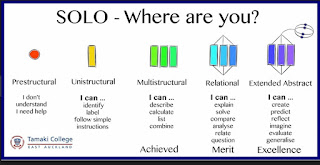
• Work with Dr. Jannie Van Hees and Mrs. Latu to help students unpack contextual questions. • Pre-test, Halfway test, End of Topic Test, These tests will help to find out; what learner has achieved, what has not been achieved, and what the student requires to best facilitate further progress. • Formative assessments and practice tests for internally assessed topics, to help in gaining internal credits. • Student feedback for every topic to improve learners' work ethic and engagement - using google forms, KWL chart, Blogging, and videos. • After school tutorials and holiday programs to bridge the gap as the learners are working between PAT1-4. • Promote Mathematical literacy/reading in class to understand the Merit/ Excellence questions to obtain better outcomes. • Teaching SOLO taxonomy to understand the breakdown of Achievement, Merit, and Excellence in NCEA to gain endorsements. • Attending Career Expos to promote meaningful vocational pathways. • Using workspace and videos to set effective lessons to revise and review the lessons before the examinations. • Using literacy strategies to understand respond and answer questions, Using the Chunk Check Chew, KWL for all topics, and Differentiated teaching.

Next step: Inquiry question 3#2

Saturday, May 1, 2021

GO SOLO As 91032 Trigonometry


I found SOLO taxonomy very useful for planning my lessons as well as learners to differentiate between Achievement/Merit/ Excellence. Here is the breakdown:


Achievement

Correct measurement and uses at least three different numeric methods in an attempt to solve the problem.

Measurement And 

1)Find any side of a right-angled triangle using Pythagoras  Theorem 2D and Pythagoras 3D.

2)Use sin, cos, and tan to find an opposite or adjacent side of a right-angled triangle

3)Use sin, cos, and tan to find an angle in a right-angled triangle


Merit

Solve a problem involving one or more of:

1)trigonometry to find the hypotenuse.

 2) symmetry of isosceles triangles.

 3)- comparing scale drawing with calculation

 4)straight-forward 3D situations

 5) vectors.

 6)Interpret bearings or grid references.

7) Angle of elevation /depression

 8)Applications

 Present my answer in a way that is easily understood

Give my answer to the problem in words

Excellence

Extended abstract thinking.
This could involve one or more of:
Devising a strategy to investigate or solve a problem.

1)Similar Triangles.

Recognise Similar triangles and use

Identify or draw triangles to solve problems

 2)Solve 3D problems involving at least two triangles.

Present my answer in a way that is easily understood

Give my answer to the problem in words

Use appropriate rounding, units, and mathematical statements.


Plan for 91032(1.7) Trigonometry


Achievement
Achievement with Merit
Achievement with Excellence

·       Apply right-angled triangles in solving measurement problems
·  Apply right-angled triangles, using relational thinking, in solving measurement problems.
·       Apply right-angled triangles, using extended abstract thinking, in solving measurement problems.


This is their second topic and will be taught between Term1/week 8 to Term2/week 2 according to the year planner. However, I am going to take more time as my learners are in the process of filling the past two-year gap. I have been working through Trigonometry.
This topic is a combination of Measurement skills, contextually based questions with right-angled triangles using Pythagoras theorem, and Trigonometry. I am very excited to dive deeper into this topic because it is a combination of Practical measurement and Trigonometry.  I am very confident this will give students another concrete foundation towards Year12 Trigonometry.
I got student input on how to teach this topic and after a discussion with my students. I made the following planning decisions:
Applying SOLO taxonomy, to work on Achievement/Merit/Excellence.
Spending more time on Practical measurement and contextual-based questions.
KWL strategy.
Translate into their own language if needed.
“Do now” questions every day to work on Trigonomtris skills.
 Dr. Jannie Van Hees will assist in tackling complicated contextual questions.
Using Google calendar to set lessons and video the lesson for rewinding purposes.
Extra classes if needed.
At the end of the topic test, I am going to get feedback from the students to get a better insight into their strengths and weaknesses in order to organize a resit if needed.
Using the online whiteboard, videos, and education perfect to make my online lessons more effective.

next topic: How to apply SOLO taxonomy for Trigonometry.

Evaluation As91026(1.1) Number


Trends and learners' voice: 
I have just finished our marking, moderation on this internal. 
Dr. Janni helped me with unpacking ideas and Mrs. Latu spent lots of time translating the practice test into the Tongan language.
19 students gained Achieved, 1 gained Merits, two of the gained Excellence, and two of them are still working on the task as they are ESOL students. 
Dr Yanee’s strategies worked too and I am going to continue to work with her to get better grades for the next topics.
There is a shift in the learners’ achievement in comparison to their PAT results. I noticed that there is a huge shift in their work ethic and have become independent learners too.  Learners and I have been worked hard to fill two years' gap within 8 weeks' time as their PAT results were from2-4. Lots of extra after-school time got spent. I am confident that I can move this forward as these learners have become very cooperative and positive towards learning. 
Definitely, these four credit Achievement Standard is going to contribute towards Numeracy credits.

According to the student's voice, they also found the task really interesting


Next step: Plan for the second topic Trigonometry

TC Staff mtg PLD